




+86 18705771231
Why Do Some Stainless Steel Pipe Exports Require Fumigated Solid Wood Cases?
views:86
date:2026-02-12
In international trade, stainless steel pipes themselves are metal products and pose no biosafety risk—the issue is never the pipes themselves, but the "outer layer" that wraps them.
Many clients ask us: Why are the same stainless steel pipes sometimes shipped in fumigated solid wood cases, and other times in plywood cases? Why do some wooden cases have a strange "wheat ear" mark printed on them? Without clarity, the consequences can range from port detention and fines to full container repatriation.
This article will thoroughly explain: The international rules behind fumigated solid wood cases, and how Xintuo Pipe Industry helps clients navigate this "invisible compliance trap."
I. Root Cause: A Global Trade Rule Born from a Tree
In 2002, the International Plant Protection Convention (IPPC) released a standard that continues to impact global trade to this day—ISPM 15 (International Standards for Phytosanitary Measures No. 15: Guidelines for Regulating Wood Packaging Material in International Trade).
Why was this standard created?
Because in the preceding decades, forest pests such as longhorn beetles and pine wood nematodes had "stowed away" across the globe inside wooden packaging, causing billions of dollars in forest losses. A single untreated dunnage plank could destroy an entire primeval forest.
The core logic of ISPM 15 is remarkably simple:
All natural solid wood packaging used in international trade must undergo phytosanitary treatment (heat treatment or fumigation) before export, and bear the globally unified IPPC mark, certifying that "this wood is safe."
China has fully adopted this standard since 2005. After January 1, 2009, all wooden packaging for outbound goods must bear the IPPC mark; otherwise, destination ports have the right to deny entry.
This is the regulatory origin of "fumigated solid wood cases."
II. The Critical Distinction: Solid Wood vs. Wood-Based Panels
Not all wooden cases require fumigation. The sole criterion is: Is the packaging material "natural solid wood" or "wood-based panels"?
| Packaging Type | Definition | Requires Fumigation/Heat Treatment? | Requires IPPC Mark? |
|---|---|---|---|
| Natural Solid Wood | Wooden cases, pallets, dunnage, frames, etc. (not deeply processed) | Yes, mandatory | Mandatory |
| Wood-Based Panels | Plywood, fiberboard, particle board, MDF, etc. | No, exempt | Not required |
| Thin Wood Materials | Veneer ≤6mm thickness, sawdust, wood wool, wood shavings | No, exempt | Not required |
Exemption rationale: Wood-based panels undergo high temperature and high pressure during production, which eliminates all harmful organisms. The risk is extremely low, and international standards grant exemption.
Common Client Misconceptions:
❌ "All wooden cases must be fumigated." — Wrong. Plywood cases do not require fumigation.
❌ "Fumigated cases are stronger." — Wrong. Fumigation kills pests; it does not reinforce the wood.
❌ "Fumigated cases are safer." — Wrong. Compliant fumigation-free packaging is equally safe and carries no chemical residue risk.
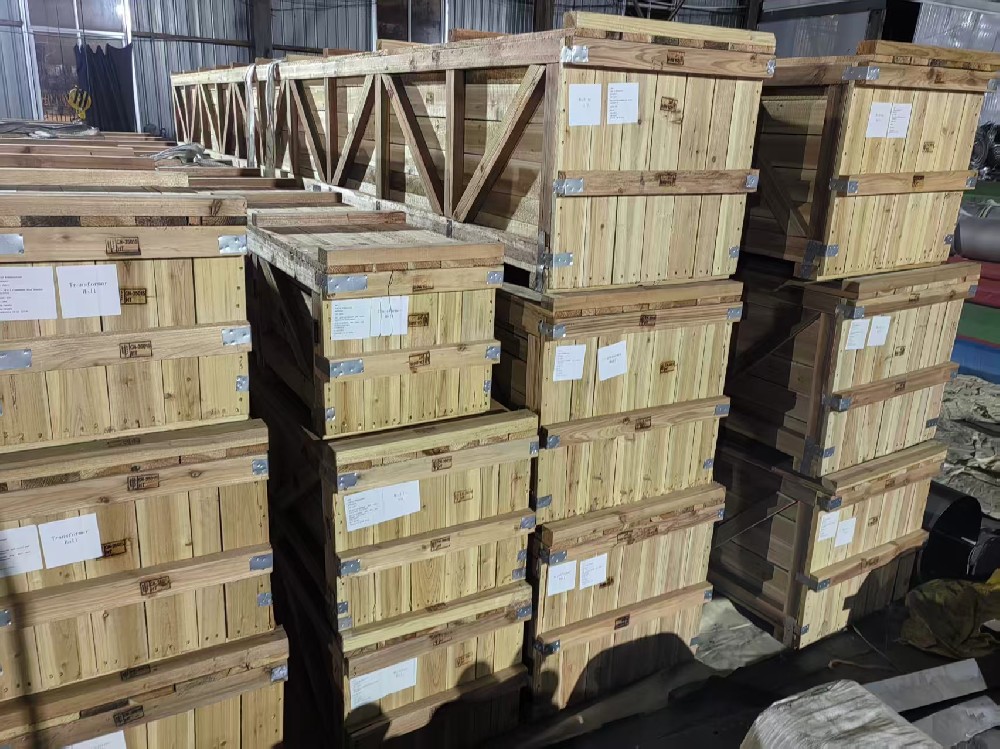
Xintuo's Professional Recommendation: For standard export orders, priority should be given to plywood cases or fumigation-free composite board cases—lower cost, shorter lead time, no customs clearance risk, and no chemical residue concerns. Only when specified by the client, for exceptionally heavy/oversized cargo, or when destination ports have special requirements, should fumigated solid wood cases be used.
III. Two Compliant Treatment Methods: Heat Treatment vs. Fumigation
If solid wood packaging is indeed necessary, one of the following two treatments must be completed before export; it cannot be arranged after arrival at the destination port.
| Treatment Method | Technical Standard | Advantages | Applicable Scenarios |
|---|---|---|---|
| Heat Treatment (HT) | Wood core temperature ≥56°C for at least 30 minutes | No chemical residue, environmentally friendly, highest international recognition | EU, Australia, New Zealand, and most countries |
| Methyl Bromide Fumigation (MB) | Temperature ≥10°C, sealed fumigation for 24 hours | Broad-spectrum insecticidal efficacy, strong penetration for large timber | Some traditional markets, but restricted in EU, Australia, New Zealand |
⚠️ Important Note: After treatment, the packaging must bear the IPPC mark, which includes:
IPPC logo
CN (China country code)
00000 (5-digit facility registration number, traceable)
HT or MB (treatment method code)
Without this mark, solid wood packaging = non-compliant packaging.
IV. Client Misconceptions & Real Risks: Two Extremes We've Encountered
In serving our clients, we have encountered two real-world extremes—both cautionary tales.
Extreme One: Fumigation Required But Not Done—Costly Consequences
A peer company, seeking to appear "more robust," unilaterally replaced a client's plywood cases with solid wood cases without fumigation or IPPC marking. Upon arrival in Europe, customs inspection detected the violation. The entire container was repatriated. Shipping costs + fines + breach of contract penalties totaled over 300,000 RMB in losses.
Extreme Two: Unnecessary Fumigation Mandated by Client—Wasted Money & New Problems
We have also encountered the opposite extreme: clients insisting that "all wooden cases must be fumigated," believing that "fumigation equals safety."
The results:
Increased costs: Each fumigated solid wood case costs 30%–50% more than a plywood case of equivalent specifications;
Extended lead times: Fumigation requires an additional 1–2 days;
Chemical residue issues: Methyl bromide fumigation leaves a distinct odor in the wood. While stainless steel pipes themselves are not corroded or oxidized by fumigation agents, during long sea voyages in sealed containers, the odor can be absorbed by wooden cases, cardboard packaging, etc. For food-grade and pharmaceutical-grade clean piping projects, clients often need to ventilate the goods upon arrival to dissipate odors. Some high-end clients explicitly require "non-fumigation certificates" or directly mandate "fumigation-free packaging."
Xintuo's Position:
We do not oppose solid wood fumigation when necessary. But we do oppose "over-packaging for the sake of reassurance."
Compliance does not require overkill—it requires getting it right. For 99% of stainless steel pipe export orders, fumigation-free plywood cases + IPPC-marked pallets are the most economical, safest, and most dispute-free solution.
V. Market-Specific Requirements: Our Early Warning System
| Country/Region | Special Requirements | Xintuo's Countermeasure |
|---|---|---|
| South Korea | Solid wood packaging from China must be heat treated; fumigation is not recognized | Confirm wood species in advance; mandate heat treatment process |
| Australia, New Zealand | Bark and insect holes prohibited; methyl bromide banned | Source debarked timber; use heat treatment (HT) |
| European Union | Packaging must be made from debarked raw wood | Control raw materials at source |
| United States | IPPC marks must be legible; blurred or detached marks are invalid | Double-side branding + waterproof ink printing |
| Food/Pharmaceutical Industry | Odor-sensitive; some clients prohibit methyl bromide-fumigated packaging | Priority recommendation: fumigation-free plywood cases |
VI. The Cost of Non-Compliance: Far Beyond Imagination
Per General Administration of Customs Order No. 238 and ISPM 15 standards, for wooden packaging that lacks IPPC marks, has non-compliant marks, or contains live harmful organisms, destination ports have the authority to take the following measures:
| Severity Level | Specific Measures | Estimated Economic Loss |
|---|---|---|
| Mild | Mandatory fumigation/heat treatment at destination port | Thousands to tens of thousands RMB, plus high demurrage charges |
| Moderate | Destruction of wooden packaging; cargo cleared unpackaged | Packaging costs completely lost; risk of cargo damage |
| Severe | Full container repatriation together with cargo | Cargo value + freight + tariffs + fines—starting from hundreds of thousands RMB |
Typical Case: In 2023, at Shanghai Port, a company exporting mechanical equipment had its wooden cases found to contain live longhorn beetle larvae during EU customs inspection. The entire container was repatriated, and a fine of 30% of the cargo value was imposed.
VII. As a Client, You Only Need to Do One Thing
When signing the contract, clearly inform us:
Destination port (requirements vary by country)
Any specified packaging material (solid wood/plywood/iron case)
End-use industry (e.g., food, pharmaceutical—odor-sensitive sectors)
Whether a fumigation certificate is required (In the vast majority of cases, no—the IPPC mark is the compliance credential)
Leave the rest to Xintuo's professional team.
Based on your cargo specifications (pipe diameter, weight, quantity), destination port quarantine policies, shipment urgency, and end-use industry requirements, we will match you with the most compliant, most economical, and most worry-free packaging solution.
Conclusion: Compliance Is Not a Cost—It Is a Responsibility
Fumigated solid wood cases have never been a "choice"—they are a mandatory requirement. When international rules mandate treatment for solid wood, we have no reason to gamble with our clients' cargo.
But equally important: When rules permit fumigation-free alternatives, we have no reason to make our clients pay a single cent more than necessary.
Stainless steel pipes are our product, but ensuring that every shipment arrives safely, compliantly, and economically at destinations worldwide—that is the true value we deliver to our clients.
Xintuo Pipe Industry: We don't just know pipes. We know export.
More News
-

Behind the AI Computing Power Surge: Why Stainless Steel Welded Pipes Have Become a “Must‑Have” for Liquid Cooling Systems
-
Inner & Outer Polished Stainless Steel Welded Pipes: Engineered for Cleanliness
-
Why Do Stainless Steel Welded Pipes Need Pickling? — Unveiling the Science and Value Behind Pickling
-
Why Do Some Stainless Steel Pipe Exports Require Fumigated Solid Wood Cases?
-
Stainless Steel Welded Pipe vs. Seamless Pipe: The Unique Advantages and Application Value of Welded Pipe