




+86 18705771231
Why Is There Such a Big Price Difference in Stainless Steel Pipes? Where Does the Gap Lie?
views:69
date:2026-03-26
When sourcing stainless steel pipes, many customers face a common question: Why do different manufacturers quote prices that vary by 30% or more per ton for what looks like the same product? What exactly accounts for these price differences?
This article breaks down the key factors behind stainless steel pipe pricing, helping you understand the “invisible value” behind the numbers and make truly informed sourcing decisions.
I. Raw Materials: The Invisible Difference
The main cost driver for stainless steel pipes is the raw material—stainless steel coil. And the quality of the coil often determines the quality of the final pipe from the very beginning.
| Factor | High-Quality Raw Material | Low-Quality Raw Material |
|---|---|---|
| Mill Source | A-grade coils from major mills such as Baosteel, TISCO, Tsingshan | Non-standard material from small mills or recycled scrap |
| Material Grade | Genuine 304/316L, composition meets national standards | 201 passed off as 304, or substandard 304 with insufficient nickel/chromium content |
| Traceability | Mill Test Certificate (MTC) provided per batch; heat number traceable | No certificate or forged certificate; no traceability |
Real-World Example: Some suppliers have been known to substitute 201 stainless steel for 304, offering a price advantage of RMB 2,000–3,000 per ton. However, 201 has far lower corrosion resistance than 304. In humid or mildly corrosive environments, such pipes may show rust spots within months. The initial “savings” often end up costing several times more in the long run.
Key Takeaway: Raw materials are the foundation of pipe quality. Without genuine materials, no amount of advanced equipment or skilled labor can compensate.
II. Manufacturing Processes: The Value of Precision
Turning a coil of steel into a finished pipe involves multiple steps: forming, welding, heat treatment, surface finishing, and inspection. The level of investment in each step directly impacts both cost and quality.
1. Welding Process
| Factor | High-Standard Process | Low-Standard Process |
|---|---|---|
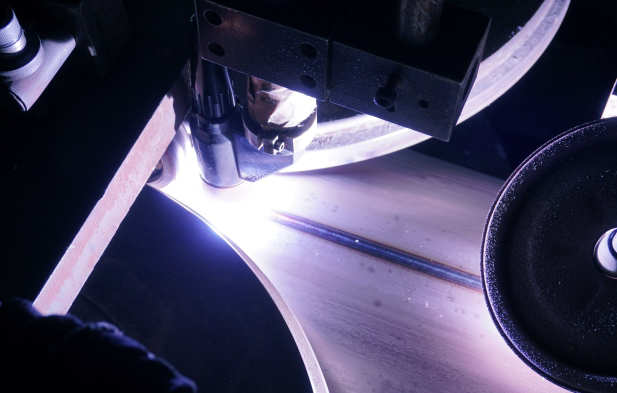
| Welding Method | Full argon-shielded TIG or plasma welding; smooth weld seam | No shielding gas or basic welding; heavy oxidation on weld |
| Weld Seam Treatment | Internal weld leveled flush with base material; no dead spots | Internal weld protrudes, creating a “step” that traps residue |
| Process Control | Precision control with matched speed and current | Operator-dependent; inconsistent quality |
Cost Impact: High-standard welding adds RMB 500–1,000 per ton but ensures corrosion resistance and fluid flow efficiency in the weld zone.
2. Heat Treatment
Pickled pipes require solution annealing to restore the corrosion resistance of the weld heat-affected zone. This process requires heating to 1050°C or higher followed by rapid cooling—a significant energy cost.
| Process | Practice | Cost Impact |
|---|---|---|
| Full Heat Treatment | In-line or off-line solution annealing with precise temperature and speed control | Adds cost but ensures full corrosion resistance recovery |
| Skipped or Simplified | Lower temperature, shorter cycle, or eliminated entirely | Saves RMB 300–500 per ton, but weld zone corrosion resistance is severely compromised |
3. Surface Finishing
Polishing, sandblasting, brushing—different surface treatments add value and visual appeal. However, the level of finishing directly affects cost.
| Surface Grade | Process Investment | Cost Difference |
|---|---|---|
| Mill Finish | Pickled only, no polishing | Baseline |
| Food Grade (240#) | Multi-stage mechanical polishing; Ra ≤ 0.4μm | + RMB 500–800 per ton |
| Mirror Finish (400#) | Precision grinding + electropolishing; Ra ≤ 0.1μm | + RMB 1,500–2,500 per ton |
III. Quality Control: Invisible Assurance
The number of inspections a pipe undergoes before leaving the factory determines its reliability during installation and long-term operation. Quality control is an “invisible” investment—but it is the one that should never be compromised.
| Inspection | High-Standard Practice | Low-Standard Practice |
|---|---|---|
| In-Line NDT | 100% eddy current or ultrasonic testing | Spot testing or none |
| Hydrostatic Test | Each pipe pressure-tested; values recorded | Batch sampling or none |
| Material Verification | MTC provided per batch; full traceability | No certificate or non-matching certificate |
| Dimensional Inspection | Continuous monitoring throughout production; tight tolerances | First and last piece only; no in-process control |
Cost Impact: A complete quality control system adds RMB 200–400 per ton. But this cost buys certainty—that every pipe leaving the factory meets specifications. It prevents costly on-site delays, rework, and potential safety incidents caused by defective materials.
IV. Delivery Capability and Service: The “Soft” Value
There is another factor embedded in price that is often overlooked: the supplier’s ability to deliver reliably and support customers. This “soft” value can be critical when schedules are tight.
| Capability | High-Quality Supplier | Average Supplier |
|---|---|---|
| Lead Time Reliability | 5,000 tons/month capacity; stock available; rush orders accommodated | Limited capacity; relies on outsourcing; unpredictable delivery |
| Customization | Fast response for non-standard sizes; one-stop processing (cutting, beveling, etc.) | Standard sizes only; long wait times for custom orders |
| After-Sales Support | Technical support available; quick resolution of quality issues | Enthusiastic before sale; difficult to reach afterward |
| Export Readiness | Familiar with international standards; compliant packaging; complete documentation | Limited export experience; risk of customs issues due to packaging/documentation |
Cost Impact: A reliable supplier’s service advantage typically adds 5–10% to the quoted price. But that premium buys peace of mind—no worries about delays, no rework due to quality issues, no customs headaches.
V. Thinking in Terms of Total Cost of Ownership
Smart sourcing doesn’t look only at the purchase price. It considers the Total Cost of Ownership (TCO) —the full cost over the pipe’s lifecycle, including procurement, installation, operation, and maintenance.
Scenario: A food processing plant needs sanitary stainless steel pipes for a dairy production line.
| Factor | Low-Price Option | Xintuo Option |
|---|---|---|
| Purchase Price | RMB 13,000/ton | RMB 15,000/ton |
| Surface Roughness | Ra ≤ 0.8μm | Ra ≤ 0.4μm |
| Weld Seam Finish | Internal weld protrudes; dead spots | Internal weld flush with base material |
| Service Life | 5 years before corrosion or fouling | 15+ years of stable operation |
| Cleaning Frequency | Weekly CIP | Bi-weekly CIP |
| 10-Year Total Cost | Lower purchase cost, but higher cleaning, downtime, and replacement costs—far exceeding expectations | Slightly higher purchase cost, but lower operating costs—optimal TCO |
Conclusion: Price Differences Reflect Value Differences
So, why is there such a big price difference in stainless steel pipes?
It starts with raw materials—genuine 304/316L or inferior substitutes.
It continues with manufacturing—precision control or corner-cutting.
It depends on quality control—100% inspection or hit-or-miss.
It is reflected in service—full support or after-sale silence.
A pipe with a low price tag may look cheaper upfront. But the hidden costs—rework due to inconsistent quality, penalties from delayed delivery, frustration from unavailable after-sales support—often far outweigh the initial savings.
When you choose Xintuo Pipe Industry, you are not paying a “price”—you are investing in value:
Genuine Raw Materials: Mill test certificates for every batch.
Precision Manufacturing: TIG/plasma welding, solution annealing, multi-stage inspection.
Reliable Delivery: 5,000 tons monthly capacity; stock available; rush orders accommodated.
End-to-End Service: From technical selection to export compliance—we support you every step of the way.
Price is short-term. Value is long-term. Choose Xintuo. Choose quality that stands the test of time.
More News
-
Behind the AI Computing Power Surge: Why Stainless Steel Welded Pipes Have Become a “Must‑Have” for Liquid Cooling Systems
-
Inner & Outer Polished Stainless Steel Welded Pipes: Engineered for Cleanliness
-
Why Do Stainless Steel Welded Pipes Need Pickling? — Unveiling the Science and Value Behind Pickling
-
Why Do Some Stainless Steel Pipe Exports Require Fumigated Solid Wood Cases?
-
Stainless Steel Welded Pipe vs. Seamless Pipe: The Unique Advantages and Application Value of Welded Pipe